Why Book Marketing Templates Fail New Authors
What’s missing from most timelines, lead magnets, and strategies, and how that gap affects real results
Most marketing advice sounds useful until you try to use it.
I sign up for a lot of author newsletters, marketing newsletters, and AI newsletters, then let them sit. After a few weeks, I go through all of them at once. Reading them back-to-back changes how they land. What sounds clear in isolation starts to feel repetitive, vague, or incomplete.
At that point, I’m not looking for inspiration. I’m looking for whether something actually works.
There are two things I pay attention to. First, does the content deliver on what it promised? Second, is the content separate from the pitch.
If someone says they’re going to translate AI tools into something actionable, I should be able to scan the email and leave with a next step I can test. A prompt, a workflow, or a specific action. If I have to interpret what they meant or fill in missing pieces, the content isn’t doing its job.
The same pattern shows up with sponsorships and affiliate links. Recommending tools isn’t the issue. The issue is when the content exists to support the recommendation instead of standing on its own. At that point, the newsletter stops being useful and starts acting like a funnel.
The lead magnet usually makes this clearer.
A good lead magnet reduces friction. It helps someone move forward without needing another explanation. A weak one looks organized but doesn’t actually solve anything.
I signed up for a newsletter that promised three book marketing secrets, two tools, and one quote each week. It’s a clean pitch, easy to understand and easy to commit to, but the lead magnet didn’t hold up.
It was a Book Marketing Timeline Template, and the problem showed up immediately. The first section was labeled “Seeding Goal,” with no explanation of what seeding actually means or how it fits into a launch. Instead, it listed options like street teams, podcast guesting, paid email promotions, Amazon ads, Facebook ads, and events.
That’s not a strategy. It’s a list of channels.
There’s no sequencing, no prioritization, and no indication of how those pieces connect. A new author doesn’t know where to start, what to ignore, or what actually matters, which makes the entire section unusable.
The next section focused on Amazon ratings and editorial reviews. You’re told to set a goal for launch week, then three months, then twelve, and to get five key figures in your niche to provide reviews.
That sounds reasonable until you try to do it. There’s no guidance on who those people are, how to reach them, what to send them, or why they would respond. Without that layer, the section stays theoretical and doesn’t produce results.
Then there’s the timeline itself, broken into Week -12, Week -11, Week -10, each with a blank space labeled “Tasks.” The structure assumes the author already knows what belongs in each week, which is where most marketing advice breaks down.
New authors don’t need empty frameworks. They need to understand what actually happens before a launch, what decisions matter, and how those decisions connect.
Without that, a timeline is just a calendar with no direction.
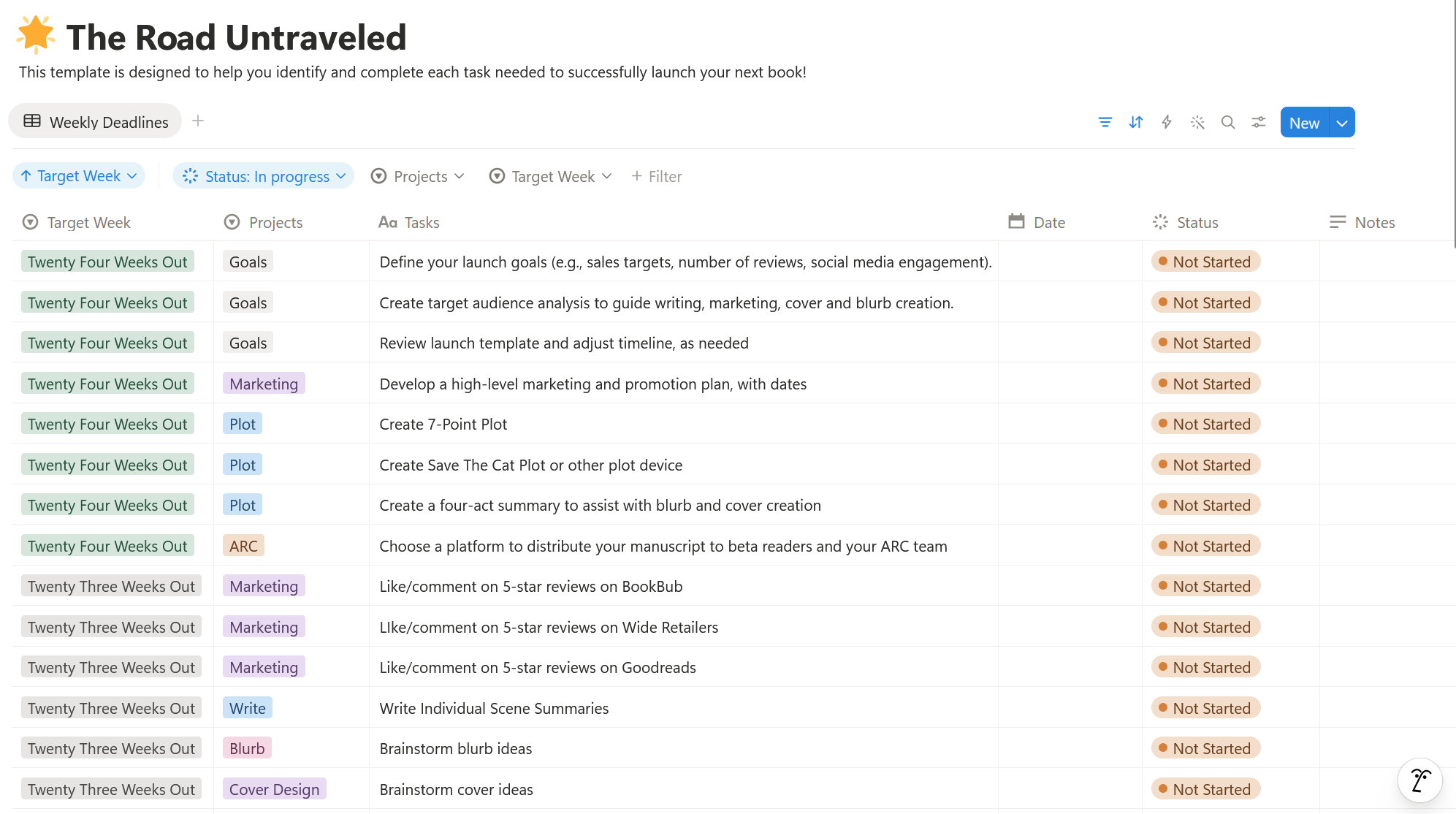
I compared it to the launch checklist I built in Notion. It’s heavier and more detailed, and it covers more than most people want to think about at once. But every step exists for a reason, and each one connects to the next.
You can remove pieces and still understand the structure. You can adjust it without losing the system. It’s not elegant, but it works.
That difference shows up across a lot of marketing advice. Clean frameworks are easier to read because they remove friction, but they also remove the parts that make them usable.
For a new author, that tradeoff is expensive.
They follow the framework, assume they’re doing the right things, and then wonder why nothing is happening. Not because they missed a tactic, but because they were never shown how the pieces fit together.
That’s the gap.
Not a lack of tools, not a lack of ideas, but a lack of structure that turns those ideas into something that can actually be executed.
If you’re not sure how to plan your book launch or what to do first, I built a Notion Book Launch Template to help you get started.
It breaks tasks down into easy steps, shows you what and when to focus on, and helps you keep everything in one place. You can adjust it to fit your book, your timeline, and how you like to work. Add items, move things around and customize your launch to meet your needs.
Get the template here.